
Why does your back ache when teleworking? Practical causes and solutions
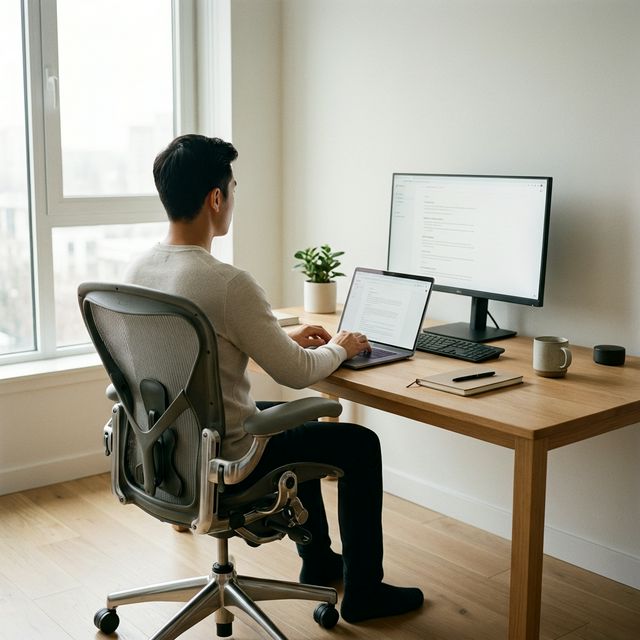
1. The "invisible epidemic" of teleworking
Working from home has given us back hours of our lives that we used to lose commuting. However, it has also brought an unprecedented increase in physiotherapy appointments for lower back pain, sciatica, and cervical discomfort.
According to the World Health Organization (WHO), lower back pain is the leading cause of disability worldwide. In the context of remote work, the main problem isn't sitting down, but how we sit and the lack of active breaks.
2. Cause 1: Excessively flexed postures
In a traditional office, furniture usually complies with certain Occupational Risk Prevention regulations. At home, it is common to see workers using dining chairs or, in the worst cases, working from the sofa or bed with their laptops.
This "C-posture", where the lumbar spine loses its natural curvature (lordosis), subjects the intervertebral discs to 40% more pressure than standing upright. When this pressure is maintained for 8-hour workdays, the back's stabilizing muscles tire, letting the weight fall onto passive structures and causing acute pain.
3. Cause 2: The drastic reduction in mobility
Although it might seem contradictory, you move more in a standard office: you go to the coffee machine, walk to the meeting room, or simply get up to talk to a colleague. At home, your whole world is just a click away on the same screen.
This lack of "micro-movements" freezes the muscles in prolonged isometric contractions that restrict blood flow and increase joint stiffness in the hips, which is directly connected to lower back pain.
4. Immediate ergonomic solutions
Fortunately, you don't need to spend thousands of euros redesigning your home office. Small adjustments yield great results:
- Screen alignment: The top edge of the monitor should be at your eye level.
- 90-degree rule: Your knees and elbows should form right angles (90º) while typing.
- Use a footrest: If your feet don't touch the floor when raising your chair to reach the table comfortably, you need to bring the floor up to you.
- Pelvic support: Ensuring that the hips are slightly above the knees makes it easier for the spine to passively maintain its natural curvature.
5. Physical solution to pain: Visual and anatomical help
If after adjusting your monitor's position and taking breaks the pain persists in your lower back or you experience sciatica-like pinches when standing up, it's a sign of continuous disc strain.
For these specific situations, U-shaped memory foam orthopedic cushions have proven highly clinically effective in redistributing ischial weight and leaving the coccyx "floating," thereby relieving nerve compression.

Memory Foam Ergonomic Cushion
Safe Universal Choice